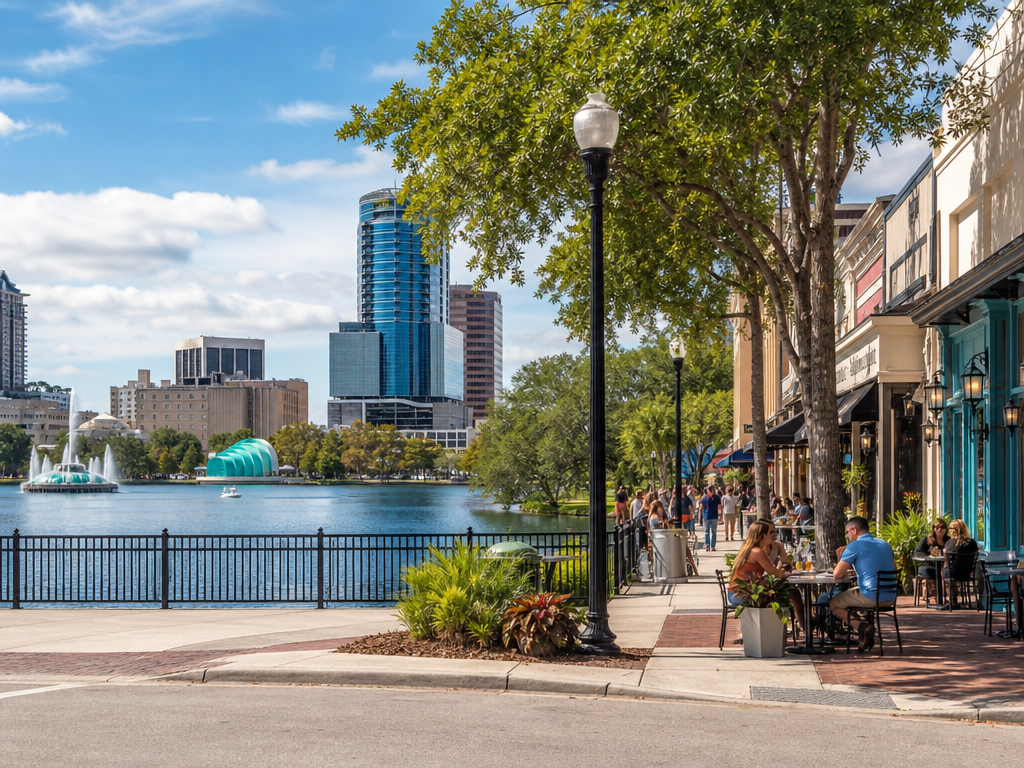
Orlando gets a lot of credit for tourism and almost none for its small business ecosystem, which is a shame because the latter is genuinely worth paying attention to. The metro area has added roughly 1,500 net new small businesses per year over the last half-decade, fueled by a combination of population growth, a relatively low cost of commercial real estate compared to Miami or Tampa, and a steady influx of transplants who arrive with skills and savings and eventually decide to build something. But the same dynamics that make Orlando attractive also create predictable traps — seasonal revenue swings, brutal competition in hospitality-adjacent categories, and a local market that’s more price-sensitive than newcomers expect. What follows is a ground-level look at what’s actually shaping the orlando business landscape right now, written for people who either run something here or are thinking about it.
1. The Tourist Economy Is Both Your Best Customer and Your Worst Business Model
About 74 million people visited the Orlando area in 2023, according to Visit Orlando, and every one of them represents a potential transaction. Food trucks near convention centers, specialty retail in tourist corridors, experience-based businesses like escape rooms or cooking classes — these categories can generate extraordinary revenue for a few months a year. The problem is that operators who build their entire model around tourist traffic often discover in January and September that their “busy season” business was masking a structurally broken cost structure.
The businesses that navigate this well treat tourist revenue as a windfall and build their operating budget around the local repeat customer. A good example of this approach is the cluster of independent coffee shops and specialty grocers in the Mills 50 district and the Milk District — neighborhoods where the customer base is almost entirely local, rents are lower than International Drive, and word-of-mouth compounds over years. Building a dual-track customer base — capturing tourist dollars while cultivating neighborhood loyalty — is harder to execute, but it’s what separates five-year businesses from two-year ones.
2. Industrial and Light Commercial Space Is Tighter Than It Looks
One of the less-discussed pressures on the orlando business environment right now is the compression of light industrial and flex commercial space. Warehouse and workshop square footage in Orange and Seminole counties has tightened considerably since 2021, driven partly by e-commerce logistics demand and partly by the conversion of older commercial strips to mixed-use residential. If you run a business that needs a loading dock, a paint booth, a commercial kitchen, or any kind of fabrication space, you should expect to pay meaningfully more than you would have three years ago — and expect fewer options when a lease expires.
Practically speaking, this means businesses in trades, food production, and light manufacturing should be thinking about lease terms earlier than feels necessary. Locking in a three-to-five year lease on functional industrial space in areas like Goldenrod, Apopka, or the western edge of Osceola County is often smarter than waiting. The businesses getting squeezed are the ones that assumed their current space would remain available and affordable indefinitely.
3. The Workforce Math Has Changed Significantly
Florida’s unemployment rate has hovered around 3.3 to 3.5 percent for the better part of two years, which sounds good in a macro-economic sense but creates real operational stress for small businesses in Orlando that compete for hourly workers against Disney, Universal, and a dozen major hospitality employers who can offer benefits packages that most small operators simply cannot match. Turnover in food service, retail, and personal services is running high, and the cost of constant recruitment and retraining is a line item that rarely appears in early business projections.
Operators who are managing this well tend to do a few specific things differently: they invest in scheduling predictability (hourly workers consistently rank unpredictable schedules as a top reason for leaving), they promote faster than feels comfortable, and they build genuine career tracks even for roles that have historically been treated as interchangeable. It’s worth noting that the U.S. Small Business Administration’s hiring guidance has useful frameworks for small operators building retention programs without enterprise HR budgets.
4. Neighborhood Differentiation Is Real and Matters More Than Ever
Orlando is not a monolithic local market — it’s a loose confederation of distinct communities with different demographics, income profiles, and spending habits. Winter Park is not the same market as Pine Hills. Thornton Park is not Hunters Creek. College Park is not Kissimmee. Businesses that treat the entire metro as a uniform customer base consistently underperform businesses that go deep in a specific neighborhood and become genuinely embedded in it.
This plays out in practical decisions like where to locate, where to advertise, and which community organizations to join. The Milk District Main Street program, the Mills 50 Main Street initiative, and similar neighborhood-level business associations are genuinely useful — not just for networking, but for understanding what the local customer base actually wants and for getting early signals when something in the neighborhood is changing. New residents in gentrifying areas like Parramore and parts of Pine Hills represent a different kind of opportunity: underserved local market segments that large chains ignore and that well-positioned small businesses can serve exclusively for years before competition arrives.
5. The Permitting and Licensing Environment Rewards Patience and Punishes Assumptions
Orange County’s permitting process has improved incrementally, but “improved” is relative. Businesses that require food service licenses, alcohol licenses, building modifications, or change-of-use approvals should budget significantly more time than the published timelines suggest. A food service establishment that expects a 90-day timeline from lease signing to open date should plan for five to six months, and should not sign a lease that doesn’t account for that buffer.
The businesses that handle this best treat regulatory compliance as a project management problem, not an afterthought. That means hiring a permit expediter for anything complex, building relationships with the relevant county and city contacts before submitting applications, and reading the actual code rather than relying on secondhand accounts of what’s required. The Orange County Business Licenses and Permits portal is the legitimate starting point for anyone operating within unincorporated Orange County, though businesses in city limits — Orlando, Winter Park, Maitland — fall under separate municipal jurisdictions.
6. Vertical Niches Are Outperforming Broad Categories
The Orlando small business owners who seem most confident right now — the ones not obsessing over every economic headline — tend to operate in specific, defensible niches rather than broad categories. Not “a gym,” but a gym specifically for competitive pickleball players or post-surgical rehab. Not “a restaurant,” but a West African supper club with a fixed weekly menu. Not “a marketing agency,” but an agency that exclusively serves mid-size law firms. The more precisely a business defines who it’s for and what problem it solves, the less it competes on price and the more it builds a customer base that self-selects and self-refers.
This is particularly relevant in Orlando because the metro’s growth keeps importing new residents with specific, unmet needs. A business that becomes the obvious answer to a specific question — even a narrow one — can build a durable position in a market that often feels overcrowded at the generic level.
Orlando’s small business environment in 2024 and beyond rewards specificity, local knowledge, and operational discipline more than it rewards novelty or sheer hustle. The operators doing well here aren’t necessarily the loudest or the most tech-forward — they’re the ones who understand exactly which part of this complicated, layered local market they’re serving, and who’ve built their cost structures and customer relationships accordingly. The city is genuinely growing, genuinely diverse in its economic base, and genuinely open to independent businesses. The opportunity is real. So are the traps.